Home AI Solutions Ready-made Solutions Peers & Simulation RAG & Retrieval Use Cases Frameworks Blog Deutsch Contact Us

Engineering notes

Precise. Fact-based. From production.

Since 2023 we have documented what actually works in AI systems — with numbers, sources and honest limits.

MCP and A2A — The Protocol Layer of the Agent Ecosystem

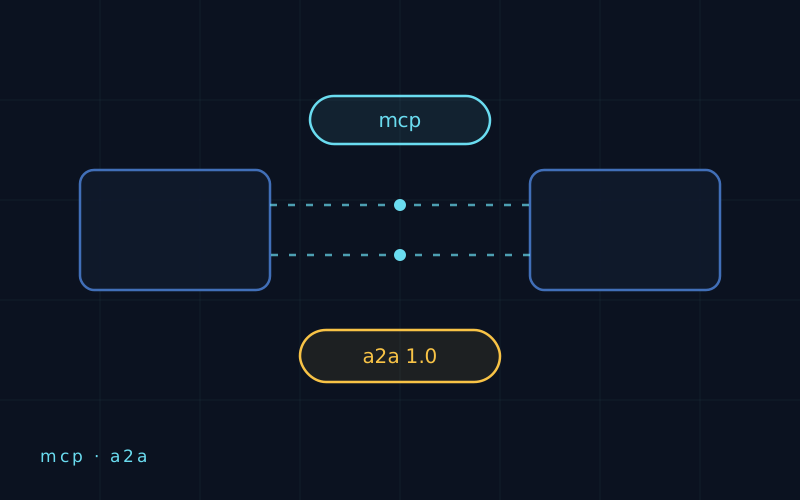
MCP's 2026-07-28 revision makes the protocol stateless and hardens OAuth; A2A 1.0 brings signed Agent Cards, multi-tenancy, and three protocol bindings. This article verifies the current state of both standards, explains how the agent-to-tool and agent-to-agent layers complement each other, outlines enterprise gateway patterns, and states precisely what the protocols do not solve: semantics and trust in content.
Subagents vs. Peer Agents — Two Working Modes of Multi-Agent Systems

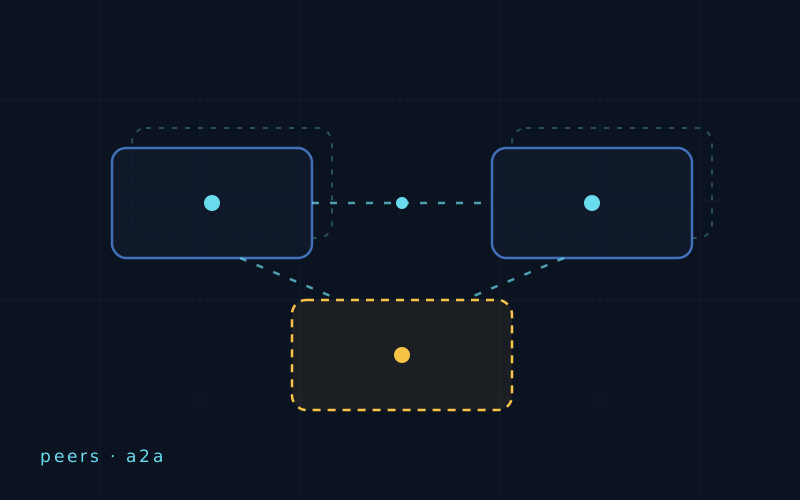
Subagents and peer agents are both called multi-agent systems, but they differ in state, lifecycle, cost, and trust model. This article separates the two working modes with verified numbers from Anthropic and Cognition, explains what A2A 1.0 standardizes — Agent Cards, tasks, contextId — shows why independence enables simulating counterpart systems, and gives six decision rules for choosing the right mode.

Simulation-First Agent Engineering

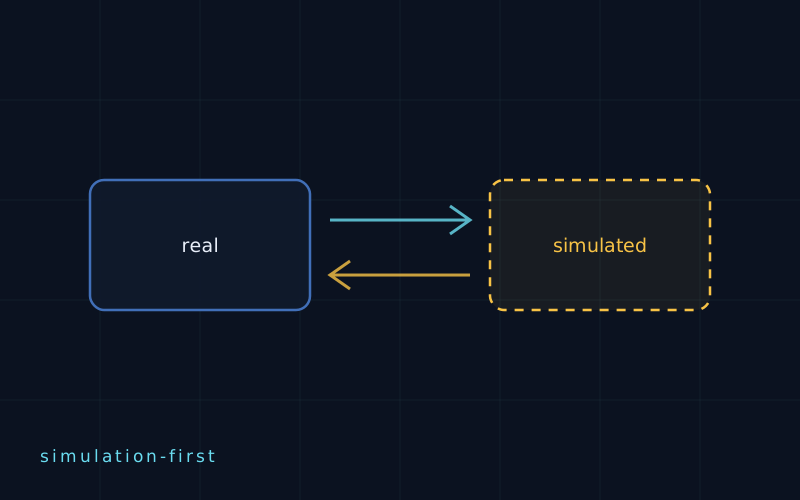
End-to-end agent journeys terminate in state changes inside authorities, ERPs, and partner APIs — systems you cannot freely test against. This article defines the simulation-first pattern: swap the real counterpart for a stateful simulated one behind the same contract. We position it against service virtualization and digital twins, cover honest labeling, load and adversarial testing, the fidelity gap, and where simulated counterpart ecosystems are heading.

Eval-Driven Development for LLM Systems

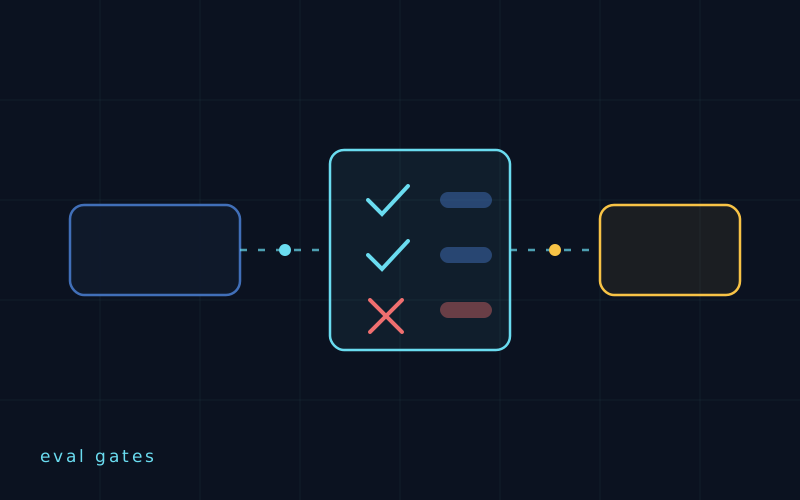
Demos prove an LLM system can work once; evals prove it works reliably. This article defines golden test sets, the four standard RAGAS metrics for RAG pipelines, LLM-as-judge with its documented biases and verified mitigations, offline versus online evaluation, and CI regression gates — plus trajectory and tool-call evaluation for agents, with numbers from MT-Bench, τ-bench, and the Berkeley Function-Calling Leaderboard.

GraphRAG — When Knowledge Graphs Pay Off

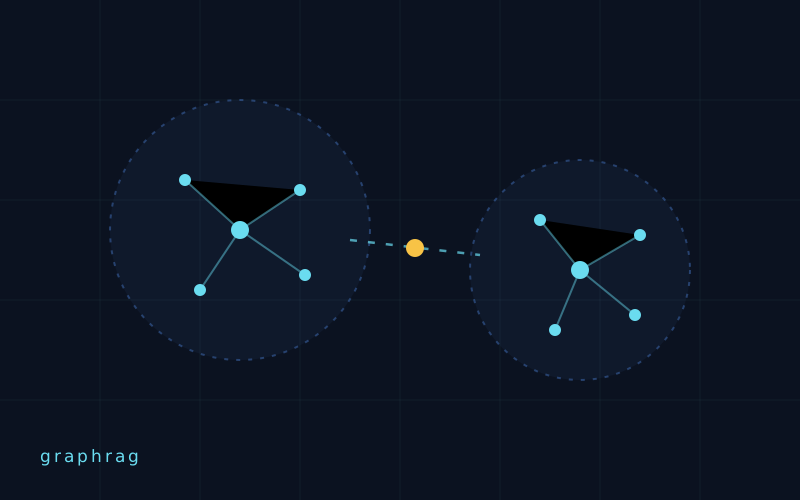
GraphRAG turns a document corpus into an LLM-extracted knowledge graph with Leiden communities and pre-written summaries, so corpus-wide questions become answerable. We check the verified numbers — 70–80% comprehensiveness win rates, LazyGraphRAG's 0.1% indexing cost and 700x cheaper global queries — and name the cases where plain hybrid RAG stays cheaper, faster, and more accurate. With five decision rules for production use.

Hybrid Retrieval Is the Production Baseline

Pure vector search misses exact identifiers, error codes, and rare terms. This article defines the production baseline for RAG retrieval: BM25 plus dense embeddings fused with Reciprocal Rank Fusion, followed by cross-encoder reranking. We verify the measured accuracy lifts and latency costs, trace the origin of the '70% of failures' claim, and state clearly when hybrid retrieval is not enough.

MCP at Enterprise Scale: Registry and Gateways

The official MCP Registry made servers discoverable and Streamable HTTP with OAuth 2.1 made them remote. Together they produced a gateway market for centralised authentication, tool-level authorisation and audit. This article covers what the registry guarantees, why the protocol invites interception, which risks a gateway does not close, and what a minimal enterprise rollout looks like.

Vector store consolidation: the deployment model decides

By 2026 the vector store decision is no longer an ANN benchmark. pgvector 0.8.2 wins where Postgres is already the data platform, Qdrant 1.17 where filtered search and memory efficiency at scale matter, Azure AI Search where a managed Azure estate needs hybrid retrieval and semantic ranking. With memory math, residency and the case for no vector database at all.

EU AI Act Article 50 — Transparency by 2 August 2026

The high-risk obligations of the AI Act are being deferred to December 2027. Article 50 is not. From 2 August 2026 providers must mark generated output in machine-readable form and disclose AI interaction; deployers must label deepfakes. We set out what to implement now — marking, interface disclosure, logging — and what the Act does not require.

Work IQ: grounding agents in organizational context

Microsoft Work IQ grounds Copilot and agents in how an organization actually works: projects, collaborators, documents, patterns. This article explains the difference between a context layer and a data lake, why permissions must be resolved at query time, what CVE-2025-32711 revealed about the remaining gap, and which six checks teams should run before adopting.

Dual-State Architectures for Agents

Chat transcripts are logs of utterances, not databases. This article describes a dual-state architecture for AI agents: one authoritative schema-validated process state per instance, with every user-facing view computed as a projection of a specific revision. We cover the pattern's roots in event sourcing and CQRS, its audit and concurrency benefits, and its honest limits.

Agent Evals in CI: Regression Gates for Trajectories and Tool Calls

Agents fail deterministic tests because the same input yields different trajectories. This article shows how to gate regressions in CI in 2026: assertions on tool calls and trajectories, offline datasets with reference outputs, online LLM judges on production traces, cost tracking per run, and eval-driven development as the working method.